US Health-Tech: ML core for posture assessment
Overview
A New York health-tech startup is building a mobile app that scans the body, analyzes posture, and recommends corrective exercises. We were contracted to design and deliver the ML core: a pipeline that turns a 3D scan into a structured posture assessment and a personalized movement plan.
At a glance
Industry
Health-tech
Goal
Enable scalable posture assessment and personalized rehab plans in a mobile app.
Tech highlights
Python, TensorFlow/Keras, (PointNet family explored), FastAPI, AWS; CI/CD on GitLab

Core Business Challenge
-
Limited labelled data for a clinically useful posture model.
-
3D analysis requirement: combine deep learning with deterministic geometry, not just 2D images.
-
Reliability and hand-off: production-ready components with proper MLOps, not research notebooks.
-
Regulatory/IP track: algorithms to be part of an FDA submission and protected as core IP.
Our Approach
-
Co-design with physiotherapists: define measurements and target conditions; review experiment results together.
-
Experimentation loop: evaluate 3D DL baselines (e.g., PointNet-style) plus mathematical/biomechanical algorithms; keep what performs best.
-
Data strategy: augmentation and label policy; prioritise features that reduce dependence on scarce labels.
-
MLOps by default: dataset/model versioning, automated train/eval, testable APIs, and deployable components integrated with the client’s stack.
AI Solution
-
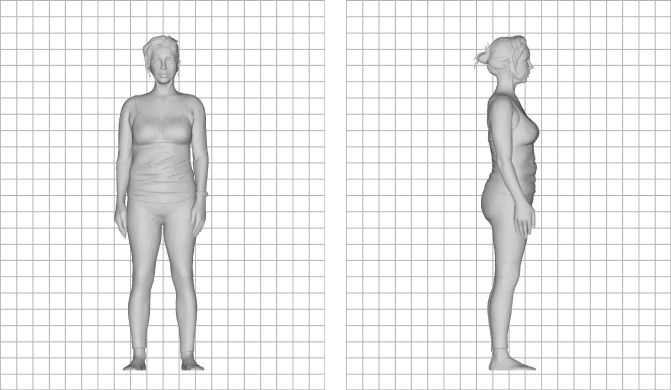
Digital-twin in, features out: convert the body scan to a 3D representation and extract features the clinicians care about (angles, curvatures, alignment).
-
Hybrid modelling: deep learning for detection/classification plus mathematical methods for precise measurements.
-
Coverage: detection/classification of 20+ musculoskeletal conditions, including spine curvature (lordosis/kyphosis), foot rotation (toe-in/toe-out), knee alignment (valgus/varus), and centre-of-mass deviations (forward/backward lean).
-
Plan generation: map findings to an exercise catalogue; produce a personalised movement plan that updates as new scans arrive. <br><br>
-
MLOps: versioned datasets/models, automated train/eval, monitored inference

Outcome
-
Clinical scope achieved: robust pipeline that identifies 20+ posture issues and outputs actionable measurements
-
Accuracy gains: combining deep learning with mathematical analysis outperformed DL-only baselines on key measurements (client tests).
-
Production-ready delivery: deployable components integrated with the client’s app/backend; monitored and versioned.
-
Regulatory & IP: algorithms included in the FDA application; patent filing initiated by the client.
-
Ongoing work: continuous model/feature updates and evaluation as the dataset grows.